
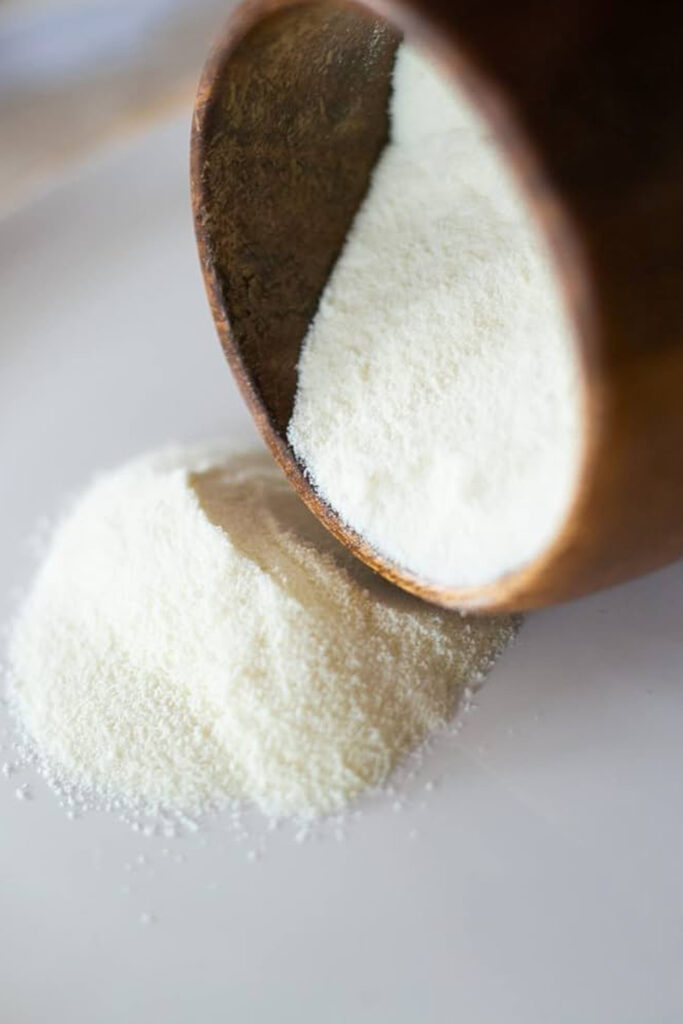
Influence of storage on chemical and physical properties of skim milk
powders
• Which flavor changes can be expected?
The flavor and odor of milk powder should be sweet and clean, entirely free from rancid or other objectionable odors. Off-flavors developing in dried milk products during storage may be due to many different compositional, processing, or other variables. In commercial situations, the presence of other foods or packaging materials during transport may also affect the flavor of dried milk products. It is important to store milk powder away from other ingredients with a strong odor, such as garlic, onions, spices, and flavorings, away from other materials with strong odors, such as gasoline, fuel oil, fertilizer, or chemicals, and away from moldy materials.
The occurrence of off-flavors may also be an indication of spoilage, microbial growth, or contamination. Bags of milk powder should be stored in a dry, clean area. Contact with spoiled foods, wet cardboard, wood, or any other material that may be moldy or has the potential to support mold growth should be avoided. A milk powder that has developed a strong, objectionable odor should not be used.
Stale or “cardboard” flavors have also been reported in different types of dried dairy ingredients, including milk powders, and may be due to a large number of factors other than storage. Off-flavors due to the Maillard reaction are generally characterized as “caramelized” or “toasted.” At high storage temperatures, these types of flavors have been described in dried milk products. A slight caramelized taste is objectionable in products such as yogurts, ice cream, and similar products. It is not a problem in other food applications, such as in baked goods and some dry blends.
• Is solubility affected by extended storage?
Extended storage of dried milk products may result in decreased solubility of proteins. The insolubility is generally attributed to the Maillard reaction, which involves reducing sugars and proteins. Storage studies of dried milk products have shown that the products stored in a variety of conditions could exhibit slight changes in solubility. The changes are not commercially important, yet it remains preferable to store milk powders at temperatures well below 40°C for a maximum retention of solubility characteristics over a long period of time.
The term solubility is also used to describe the dispersing characteristics of milk powders when reconstituted with water or other fluids. Tests to determine the “solubility” of milk powders depend upon a number of factors such as the amount of dissolved minerals, “hardness”, in the water used, speed and duration of stirring, and temperature, and other factors. The use of mechanical agitation and mild heat in sanitary conditions may be required to facilitate “wetting” and dispersion of some milk powders. For uses where the powder is blended with other dry ingredients as, for example, in baked goods, the degree of solubility of milk powder is not very critical.
• What is the impact of browning on the functionality of milk powders?
A powder that has developed extensive browning or appears to have deteriorated should not be used. Slight browning may be associated with flavor changes, making the powder less desirable in applications such as yogurt, ice cream, and other dairy products. These changes, however, are not noticeable in bakery applications. Some studies have shown, in fact, that the volume of baked goods can increase with the length of storage and degree of browning of dried milk ingredients. Typically, the level of protein denaturation achieved during the processing of milk powders is a more significant indicator of performance for industrial bakers than small changes occurring during storage.
• What is the impact of storage on the powder’s acidity? (i.e., pH level)
In some studies, the pH of milk powders stored at room temperature was shown to decrease. The pH change can also be attributed to the bonding of amino groups by lactose in the Maillard reaction. Changes in pH do not appear to be significant for a milk powder user at the commercial level.
A milk powder that has deteriorated extensively as a result of poor storage conditions, and that appears to have an unpleasant, acidic taste should not be used.
• What is the impact of storage of flow properties?
Development of stickiness, caking, and lumpiness can take place during the storage of dried milk ingredients. Skim milk powder is hygroscopic (attracts moisture) because of its high lactose content. If exposed to the atmosphere, it can absorb sufficient moisture to induce caking or the development of lumps, resulting in a powder that flows poorly or not at all. Proper storage conditions and good packaging can reduce stickiness, caking, and lumpy problems.
• What can be done if the product has “caked”?
SMP that has been exposed to excessive heat and moisture may develop stickiness and “cake,” and these changes do have commercial significance. Caked dried milk powder can be ground, after which it will remain free-flowing unless exposed to high humidity. The powder should be allowed additional time to dissolve, and may require additional stirring. In all cases, when recombining milk, clean potable water should be used and the appropriate heat treatment applied to the product after reconstitution.
If the moisture uptake is such that off-flavors have developed, the product or its packaging appears moldy or seems to have deteriorated, the milk powder should be discarded. Milk powder from any bag that has been opened before use or appears to have been tampered with should never be used.
• How does browning develop in milk powders?
Ordinarily, browning is not a major type of deterioration in SMP during storage. Nonenzymatic browning can take place in SMP as in many casein-lactose systems. Nonenzymatic browning via the Maillard reaction is one mode of deterioration in milk powders, which may limit shelf life. Milk powders contain relatively high concentrations of lactose and protein, high in lysine (an amino acid) content. In the presence of moisture, these components readily participate in the Maillard reaction. This interaction may result in changes in protein quality that are accompanied or followed by undesirable color changes. Non-enzymatic browning occurs during the processing of many foods, such as baked goods, and is not a safety problem.
• Which factors contribute to color changes in milk powder?
The most apparent visible change in SMP after storage is a light brown color. This color can develop in milk powders stored at room temperature, as well as in milk powders refrigerated for a period of three years. Browning occurs faster as the storage temperature is higher, or if bags of SMP have been opened. Some studies have shown that browning may occur faster with increased moisture content of the product itself. Typically, both the temperature and humidity of storage conditions affect the Maillard reaction. Uptake of moisture by milk powder is mostly attributed to the hygroscopic nature of the lactose. These changes can occur in any natural dehydrated milk product.
At every water activity level, the color index (which measures Maillard reaction browning) increases with increasing storage temperature, especially in the 20-40°C range and storage time. To achieve good retention of the original attributes of milk powder during storage, Temperatures should be below 20°C and the water activity below 0.2