
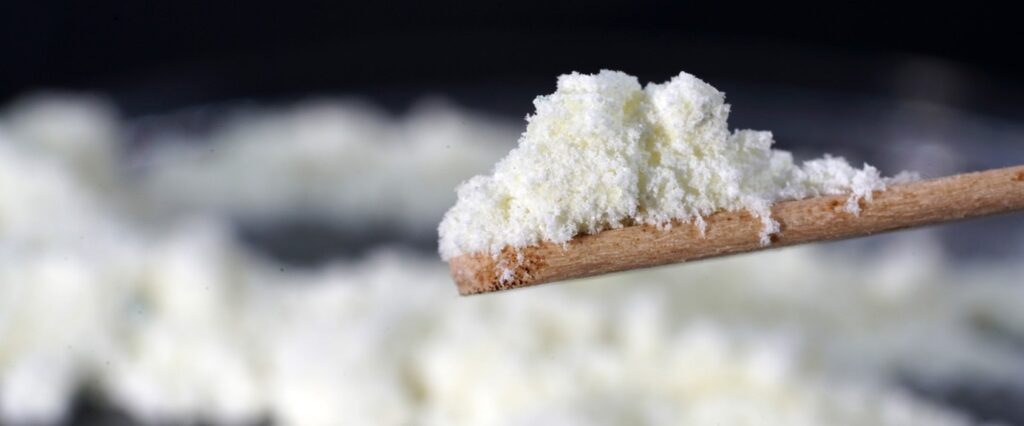
Influence of storage on the nutritional value of skim milk powders
Lysine and the sulfur-containing amino acids are principal among those that suffer some slight destruction during the high-temperature treatments of milk or the Maillard reaction. Protein quality losses can occur during normal storage. Studies have shown that the methionine and tryptophan content do not change significantly during storage at temperatures ranging from –40 to 40°C and water activities in the 0.15 to 0.41 range. The available lysine decreases most at high water activity and at the highest temperature. However, losses of lysine after 6 months of storage at 20°C (at any water activity level) are less than 8% (typically less than 6%). It is only during extended storage (over 6 months) at temperatures exceeding 40°C and at high water activity that the loss of lysine, and therefore the change of nutritional quality of milk proteins, becomes more significant (with losses of 15-24%). Such extreme conditions are rarely encountered in commercial situations.
• Is the biological value of milk protein reduced during storage? The biological value of milk proteins is not significantly altered during the manufacture of milk powders or during storage in good conditions for an extensive period of time. Maintaining the nutritional value of milk proteins during storage is not a problem. provided the temperature is kept below 40°C, and the water activity (humidity) is low.
• Is vitamin content affected by storage in milk powders? The amounts of thiamin (B1), riboflavin (B2), niacin, calcium pantothenate, biotin, and pyridoxine present in dried milk are quite comparable to those of market milk. They are not affected by storage for 6 months at 35°C. Vitamin C content is slightly reduced during storage for 6 months.
Expected shelf-life
• What is the expected shelf life of milk powder that has been transported or stored for three months at temperatures above 35°C? Storage at high temperatures can reduce shelf-life because some reactions, such as non-enzymatic browning, are temperature-dependent. It is the combination of heat and high humidity that will significantly reduce shelf life. For example, studies have shown that storage for 3 months at 37°C and 90 percent relative humidity is equivalent to storage for 12 months at ambient temperature in temperate climates (approx. 15-25°C, 80% RH or less). Therefore, the remaining shelf-life may be reduced by a factor of 4 if the powder is stored in high heat/ high moisture conditions. Increases in the moisture content of the milk powder will cause browning and caking first, and while SMP will be safe, it will be harder to use. Further increases in the moisture content of SMP (above 15%) may allow bacterial growth, and the SMP should not be used.
If the uptake of moisture is due to packaging failure or punctures, or if it appears that the product has been tampered with in any fashion, the milk powder should not be used.
Storage and safety issues
• Is milk powder that has been stored for a long time safe microbiologically? Milk powder made from good-quality milk and containing low microbial counts is microbiologically safe during storage, provided the moisture content is kept low during storage. Bacteria, yeast, and mold will not grow in milk powder that has been stored in good conditions.
Powder that has been exposed to water or excessive humidity during storage (so its moisture content is above 15%) can sustain microbiological growth, and should not be used.
Testing quality
• Are there quick field tests to evaluate the SMP’s condition?
Milk powders should be evaluated organoleptically, chemical-physically, and microbiologically to determine the quality and condition fully. However, an organoleptic evaluation test is the only test that can be performed with minimum equipment. The organoleptic evaluation of reconstituted skim milk powder should have a taste and smell close to that of milk. A slightly cooked flavor and aroma are acceptable.
Sensory Evaluation of Milk Powder (adapted from IDF Standard 99B)
Sample preparation
The required quantity is reconstituted by dissolving milk powder in water according to the following formula: 10 grams of skim milk powder in 90 grams of water. The reconstitution should be done at 25°C in colorless and tasteless water of excellent microbial quality. The skim milk powder should be mixed thoroughly in the water, preferably in a glass container. Proper mixing is achieved with an electric mixer. The reconstituted milk should be stored in a covered glass container for approximately one hour at 20°C before evaluation. Also, intense light should be avoided.
Assessment
The reconstituted milk is examined for:
1. Appearance –
What is examined? Color, visible purity, presence of lumps, flakes, hard granules, or sediment.
Uneven color, browning, presence of lumps, hard granules, scorched particles, free fat, and free protein are indications of poor quality.
2. Flavor –
What is examined? Flavor and odor of reconstituted milk.
Reconstituted milk should have a sweet, pleasing, and desirable flavor and may contain chalky, cooked, feed, or flat flavors to a slight degree. It should be free from undesirable flavors such as burnt, oxidized, bitter, tallowy, fishy, cardboard, metallic, oily, stale, rancid, salty, foreign flavor, chemical flavor, or putrid.